

Injection Well Facts
Ohio Department of Natural Resources response to questions submitted by Marietta City Council
-
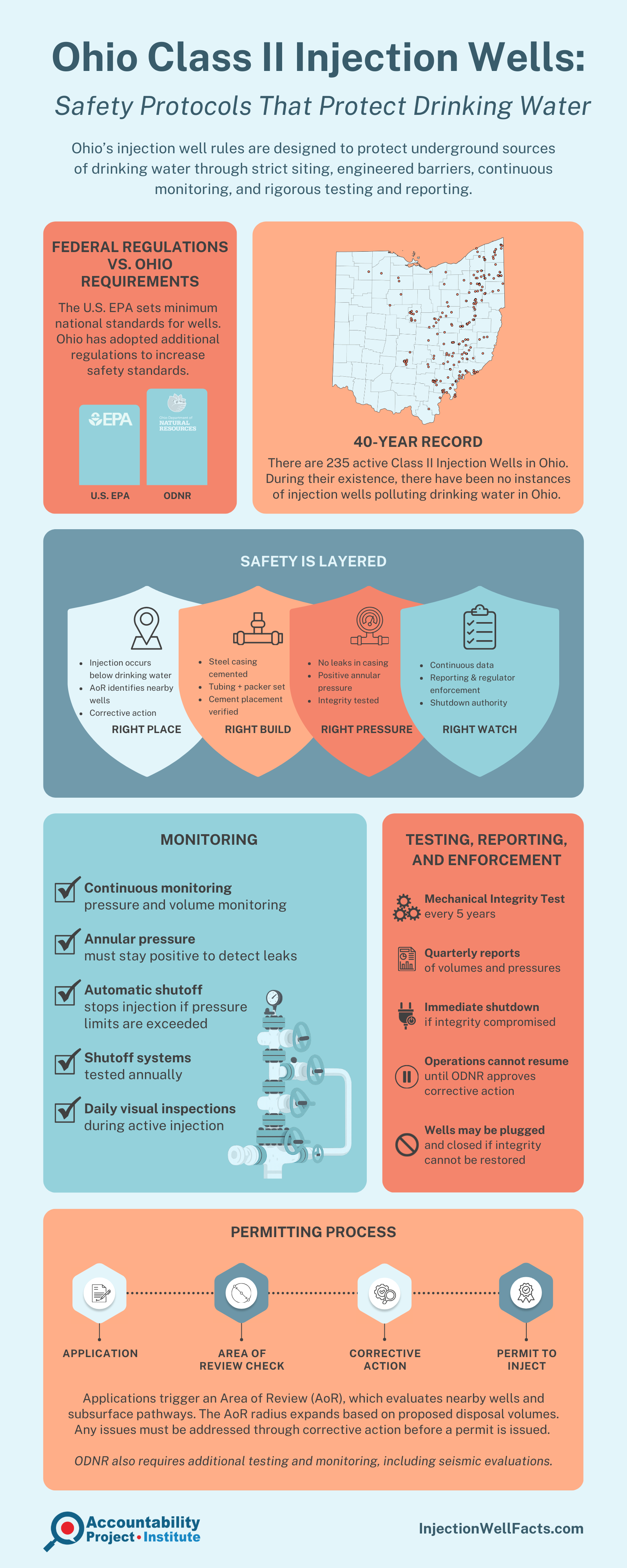
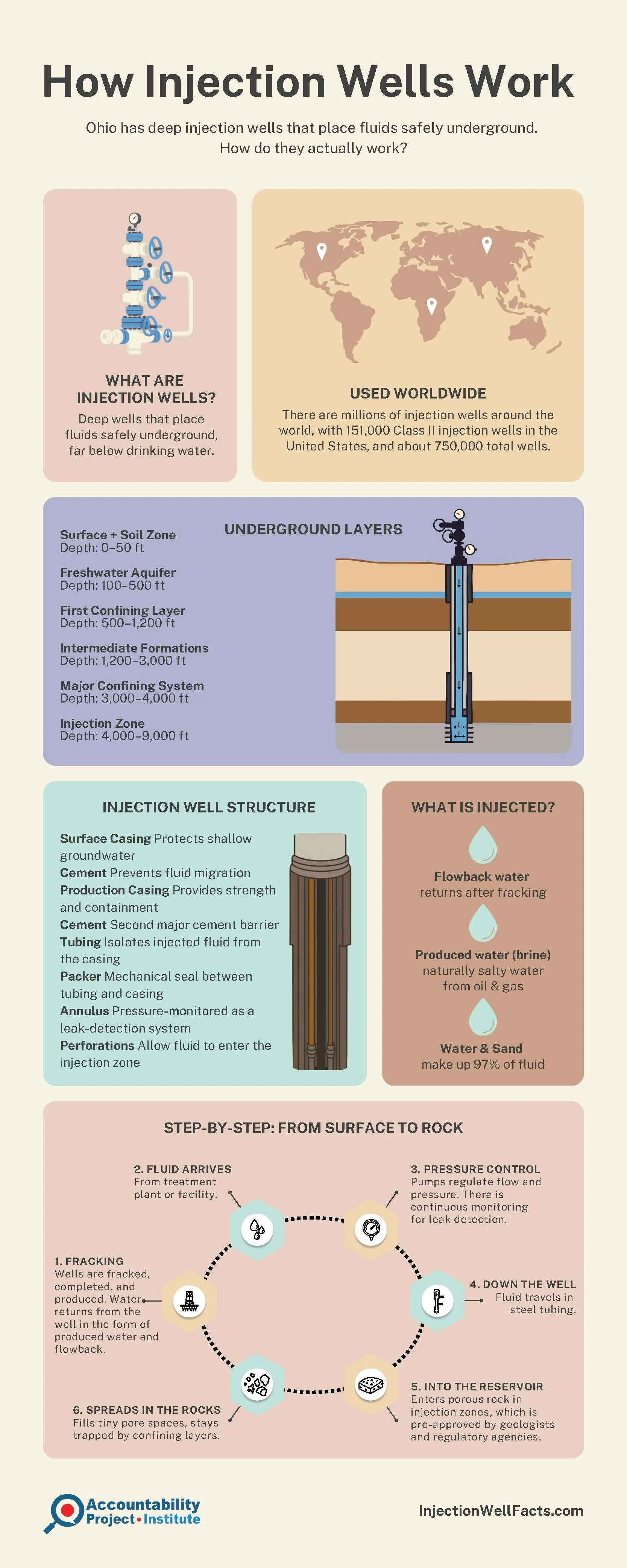
Oil brine disposal injection wells are deep, scientifically engineered systems, akin to vertical vaults, that send brine water —naturally occurring byproducts of oil and gas production —down into rock layers that have held saltwater for millions of years, thousands of feet below the water table. The result is to keep the byproduct of oil and gas production safely away from people and water supplies.
In Ohio, the oversight and approval of injection wells are handled by certified professionals at the Ohio Department of Natural Resources (ODNR). Nationally, the U.S. Environmental Protection Agency has strict regulations that must be met.
Wells are defined by classes. The two pertinent classes here are Class II wells, which contain oil/gas wastewater, and Class I wells, which contain industrial waste. The wells must be drilled to allow for fluid injection thousands of feet below the lowest underground source of drinking water.
Each well is built with multiple layers of steel casing and cement.
Class II wells have been regulated by ODNR since 1983. The move reflected confidence that Ohio could uphold federal standards. In 1983, the EPA formally granted primacy over the regulation of Class II injection wells to ODNR.
This allowed Ohio to develop and enforce its own Underground Injection Control (UIC) program under the framework of the Safe Drinking Water Act (SDWA).
Injection pressures and operational standards are set and monitored by the ODNR.
The ODNR coordinates step rate testing to ensure the structural integrity of injection wells.
Step Rate Testing is performed by injecting fluid in small steps, testing the pressure at each level. This helps identify the fracture pressure at which cracks might form. By identifying this, the injection can be made safely without damaging the surrounding rock or risking leaks.
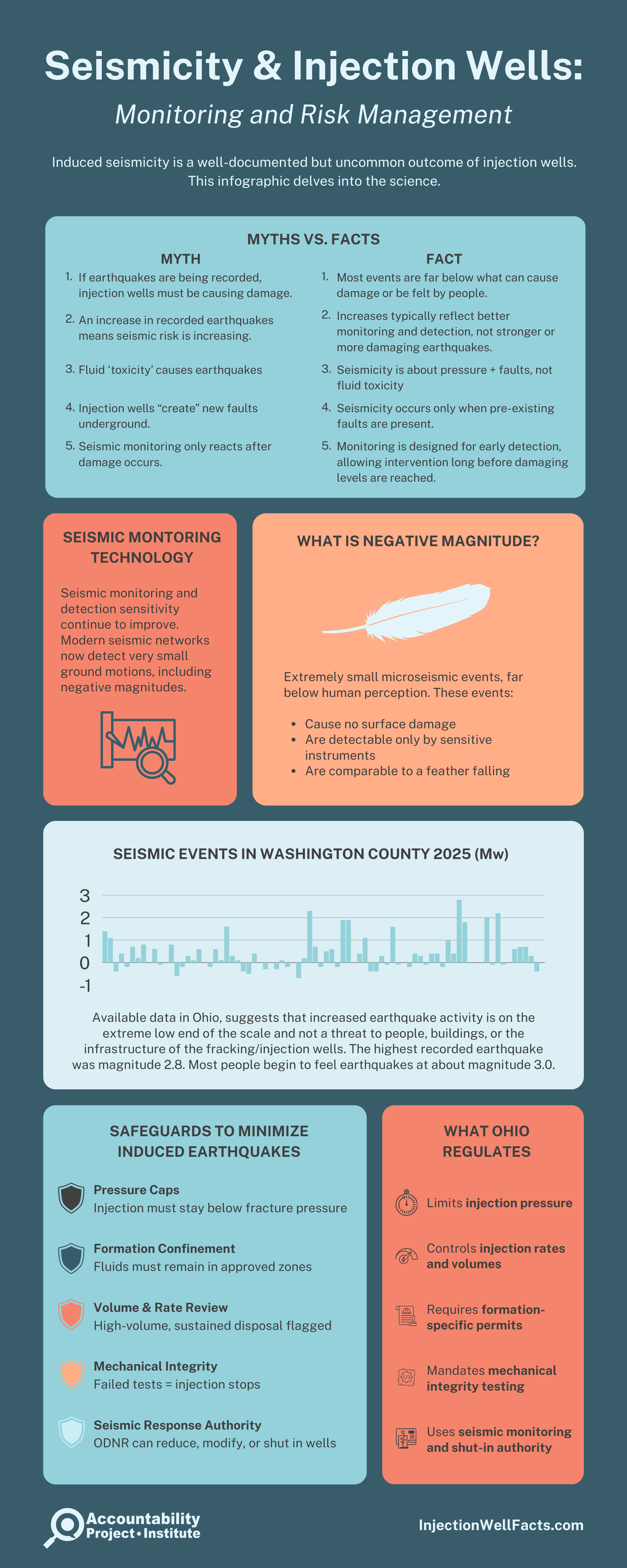
Many such sites, including DeepRock’s, are equipped with seismic monitoring, and wells are fitted with continuous pressure monitoring to detect anomalies that can be quickly addressed and rectified.
Regular inspections – often unannounced – are conducted by ODNR to ensure compliance.
Further environmental controls include filter bag testing of brine, monitoring fluid levels in tanks using radar and laser technologies to avoid overflows, and leak detection systems for the double-walled piping and containment tanks.
The ODNR requires reports about brine volumes on a scheduled basis.
Besides the ODNR, companies maintaining injection wells collaborate with multiple federal and state agencies, including the U.S. Environmental Protection Agency (Spill Prevention, Control, and Countermeasure plan), the U.S. Army Corps of Engineers (barge permit), and the U.S. Coast Guard (approved Maritime Transfer Facility & Facility Response Plan).
-
Marietta City Council are attacking ODNR despite the fact that ODNR has been the regulatory agency in charge for 50 years with no incidents of water impact. Why now?
The handling of this situation is a prime example of bad government in action.
Our analysis suggests that the entire affair is a vendetta carried out by Susan Vessels.
Council’s actions should be incredibly troubling for residents:
Racing toward an unwinnable lawsuit.
Abusing the city’s “emergency” clause to rush legislation.
Refusing to take a thoughtful approach, study, and report facts.
Council President Susan Vessels unethically recorded a private meeting and leaked it to reporters.
The City of Marietta has ignored lawful and routine public records requests for Susan Vessel’s communications.
Writing a letter in opposition that is filled with, at best, misinformation and, at worst, flat-out lies.
Make no mistake, the threatened lawsuit is a bad deal for Marietta taxpayers. It lacks standing, is unlikely to succeed, and it will be very costly.
The only thing being poisoned in Southeast Ohio is the truth, and Susan Vessels is the source.
Susan Vessels was thrown out of the Rebublican Party for her actions.
Susan Vessels’ husband Ethan Vessels is an attorney who actively sues the oil and gas industry.
-
The environmental lobby and their shill, Susan Vessels, are using inflammatory, fearmongering, and speculation to aggravate the community.
Statewide, the oil and gas industry supports hundreds of thousands of jobs across Ohio and contributes tens of billions to Ohio’s economy. The sector is responsible for 290,000 barrels of crude oil & over 6. billion cubic feet of natural gas annually.
According to an analysis by Cleveland State University, natural gas and oil development in the Muskingum Watershed Conservancy District (MWCD) generated $1 billion in economic activity in the region over nine years, directly supporting more than 2,600 jobs totaling nearly $300 million in wages and benefits, and generating increases in state and local tax revenue and growth in related industries such as transportation, tourism, and infrastructure.
What-ifs aren’t science. Injection wells are safe and well-regulated. Each of us can identify numerous doomsday scenarios, but hypotheticals cannot drive government policy.
-
The distance between an injection well and a water source has no bearing on the potential danger. The U.S. EPA’s Underground Injection Control (UIC) program, created under the Safe Drinking Water Act, examines the well’s depth and the effectiveness of its sealing.
The EPA requires at least one confining layer of impermeable rock. Rather than horizontal distance, science and federal law indicate that vertical depth and geologic barriers are the key considerations.
Injection wells are drilled in stages, with each stage lined with steel casing and cement. When complete, there are up to seven layers of steel/cement of protection.
The first casing, called the surface casing, extends deep enough, at least 100 feet, to pass below the lowest underground source of drinking water.
There is often a concern about seismic activity around injection wells. Out of 232 active oil brine wells in Ohio, Peer-reviewed research and the ODNR have found very few tied to any sort of suspected seismic activity.
-
Some have suggested that those seeking permits for injection wells must abide by newly formed regulations, despite having filed the permit application under previous rules. This is patently false.
Permits are considered under the regulatory environment in place at the time of filing.
Imagine you studied hard, took your driver’s test, and passed under the existing rules. Then, a week later, someone says, “Sorry, we just changed the test. You’ll have to retake it, even though you already did everything right.” That would be unfair—and it’s not how the system works. Ohio law is clear on this subject.
-
Let’s correct the record: These organizations portray themselves as saviors.
They don’t have your best interests at heart; they have a radical environmental agenda and are sowing discord to shut down the oil and gas industry, not one well in Washington County.
They’re woke left-wing environmental zealots.
EarthJustice is funded in part by the liberal MacArthur and Ford Foundations. These organizations support liberal causes such as Planned Parenthood, those pushing climate change, the ACLU, PBS, the NAACP, the Sierra Club, and the Brookings Institution.
The Buckeye Environmental Network receives funding from the Tides Foundation, which is affiliated with Earthjustice, the MacArthur Foundation, and the Ford Foundation.
Despite having an Athens County headquarters and a commitment to “protecting forests,” BEN has donated to numerous groups outside of Ohio, and the individuals involved have connections that are a who’s who of the environmental left.
-
Let’s correct the record here, too.
DeepRock strengthens the local economy.
It offers good-paying local jobs, tax revenue, and community investment through (to provide some examples) donations and/or sponsorships benefitting the Marietta Community Foundation, the Washington County Fair, and local food banks. In fact, DeepRock was recognized as Philanthropist Organization of the Year by the Marietta Community Foundation in 2023.
Its employees live and raise families in Marietta, giving them a personal stake in maintaining safe, environmentally responsible operations—especially when it comes to protecting the local drinking water.
DeepRock is NOT Brian Chavez.
Senator Chavez’s family owns an interest in DeepRock, but he stepped away from active involvement when he was appointed to the State Senate.
Under Senate ethics rules, Senator Chavez must be careful to avoid conflicts of interest and has done so.
As the Energy Committee Chairman, he believes that Ohio’s energy sector is an essential driver of our economy, and he’s in a unique position to help ensure that the industry acts safely on behalf of Ohio residents while avoiding the regulatory burden sought by environmental activists intent on strangling the sector.
-
The saltwater (brine) that comes out of oil and gas formations is naturally radioactive before it ever reaches the surface because deep rock layers contain trace amounts of naturally occurring radioactive materials (NORM). The brine contains trace amounts of radioactivity. This radioactivity is not created by drilling or injection; it is a property of the ancient rock and the water trapped in it for millions of years. When the fluid is later injected into a permitted Class II disposal well, it is no more radioactive than when it was originally drawn from the formation. The injection process does not increase, concentrate, or amplify radioactivity in the fluid. The well simply returns the naturally occurring fluid back into deep geologic formations where it came from.
-
Ohio takes more injection fluid than neighboring states because its deep geologic formations are thick, laterally extensive, and highly suitable for long-term fluid storage. These formations provide stable pressure conditions, predictable geology, and large pore space capacity, making Ohio one of the safest and most practical disposal locations in the region. West Virginia and Pennsylvania also accept injection fluid, but their usable formations are generally smaller, more fragmented, and typically less suited for high-volume disposal. As a result, Ohio’s geology explains why it handles a greater share of the region’s oil-and-gas wastewater.
-
Before Ohio adopted its updated 2022 Area of Review (AoR) rules, the state’s earlier regulatory framework was already stricter than the federal minimum standards required under the U.S. Environmental Protection Agency’s Class II Underground Injection Control (UIC) program. While federal rules require only a fixed quarter-mile AoR, Ohio had long required broader reviews, more detailed geologic analysis, stronger well-construction standards, mandatory mechanical integrity testing, and closer oversight of orphaned and plugged wells. In other words, even the previous Ohio regulations provided a higher level of protection for groundwater than the baseline federal requirements, and the 2022 updated regulations made them more conservative.
There are 232 active Class II Injection Wells operating in Ohio. Some wells are commercial, some are for private use, but all are subject to state and federal oversight. None have ever contaminated the regions drinking water in Ohio.
The approval of permits for an injection well near Marietta, Ohio, should not be contentious; however, local politics and outside groups have caused it to escalate into a controversy. Susan Vessels isn’t serving the residents of Marietta well; she’s wielding her power to push through her radical agenda. The Accountability Project Institute is committed to holding elected officials accountable to the people and has been studying this issue for several weeks. We are a voice of reason, conducting research and ensuring that the residents of Marietta have access to facts, rather than misinformation and hypotheticals. Please check back often. If you have a question about anything here or something you feel is missing, please reach out, and we will do our best to address it.
White Papers &
Op-eds
Scientific research and opinion pieces to keep you informed.
OP-EDS
WHITE PAPER
Infographics
Scientific infographics to keep you informed.
SUSAN VESSELS PUBLIC RECORDS REQUEST
Recently obtained public records offers a revealing window into the tone and tactics of
Susan Vessels, President of Council in Marietta.
ENVIRONMENTALISTS’ FRIVILOUS
LAWSUITS FAIL AGAIN
Environmental activists continue to prove that they are not just against injection wells.
Their real goal is to stop fracking completely, kill jobs, and stop economic growth.
Myths vs. Facts
Loading myths & facts…
Questions Marietta Residents Should Ask
- Why are city leaders pursuing a lawsuit when our water is clean and injection wells are safe?
- How much could the lawsuit cost? What’s the cost-benefit analysis? Why are we awarding a no-bid contract to a liberal environmental group?
- Why can’t we slow down, study the facts, and make informed decisions, rather than using the emergency clause to push through a political agenda?
Why This Matters
Injection wells are often misunderstood, and misinformation has made this issue more controversial than it needs to be. Our goal is to provide residents with clear, factual information so you can separate myths from facts about local injection wells, water safety, and community impact. Stay informed and empowered to make decisions based on evidence, not speculation.
Public meeting agenda
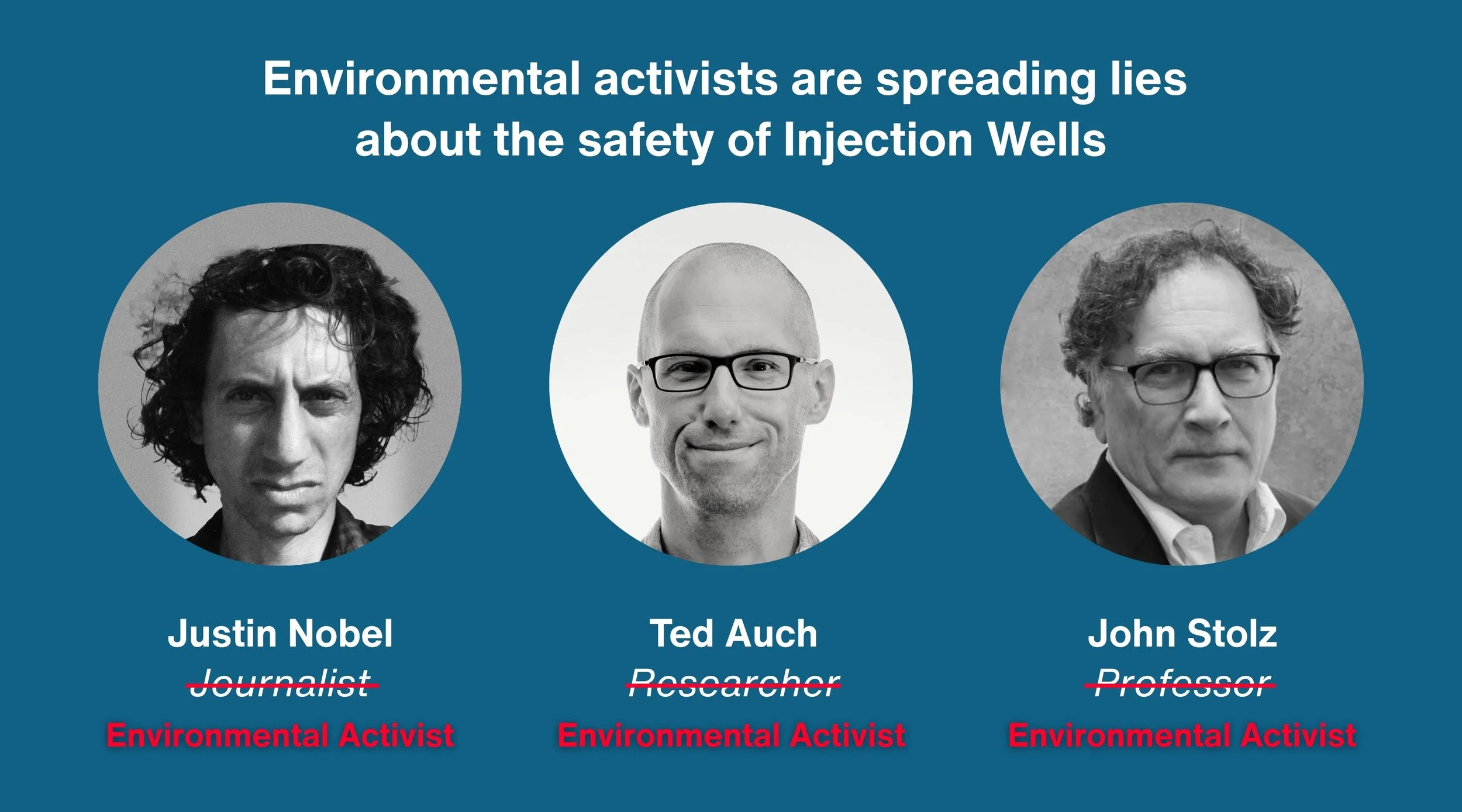
A public meeting on injection wells is being hosted in Marietta to rally the radicals. This meeting will feature 3 speakers who position themselves as environmental experts, but they are actually fundamental activists. They use innuendo and rumour to push their radical agenda. They are not anti-injection wells; they are anti-oil and gas.
How Injection Wells Work
Credit: Ohio Department of Natural Resources
Credit: Ohio Natural Energy Institue