

Public Meeting Agenda
A public meeting on injection wells is being hosted in Marietta to rally the radicals. This meeting will feature 3 speakers who position themselves as environmental experts, but they are actually fundamental activists. They use innuendo and rumour to push their radical agenda. They are not anti-injection wells; they are anti-oil and gas. Learn more about each speaker below:
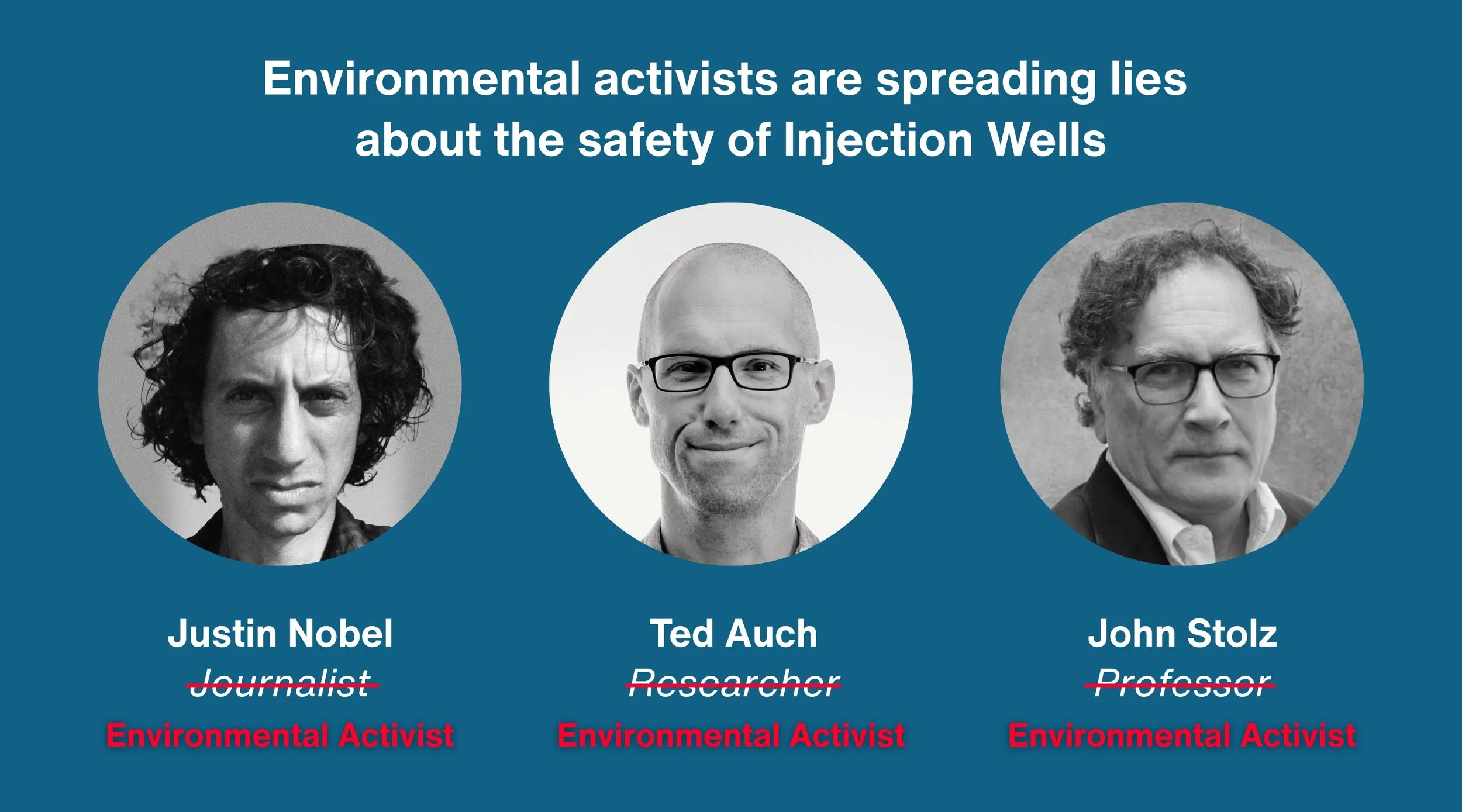
Justin Nobel
Justin Nobel’s opposition extends well beyond injection wells and into a broader, systemic critique of the Oil & Gas industry itself. Across his book Petroleum-238, his reporting for DeSmog, and his public talks in Ohio, Nobel consistently frames fracking as an inherently dangerous industrial activity, one that produces radioactive and toxic waste he believes cannot be safely managed through existing regulatory systems. While injection wells and brine hauling are recurring focal points, they are presented not as isolated problems but as downstream consequences of fracking. In Nobel’s telling, these waste-handling practices exemplify what he sees as a fundamentally flawed extraction process that generates unavoidable risks to workers, communities, and the environment.
Industry critics such as Energy In Depth (EID) argue that this framing is misleading and alarmist precisely because it discounts regulatory realities and treats fracking’s risks as intrinsic rather than contingent on compliance, technology, and oversight. EID contends that Nobel routinely emphasizes worst-case scenarios, selectively cites studies and anecdotal accounts, and underplays extensive state and federal regulatory frameworks governing fracking, TENORM, waste disposal, and the importance of injection wells. Nobel’s work is not a narrow critique of specific practices like injection wells, but part of a broader narrative that portrays fracking itself as unsafe and unmanageable. He is an environmental activist masquerading as an industry expert.
Ted Auch
Ted Auch has a long record as a fracking industry critic and activist, not just a commentator on injection well regulation. For more than a decade, he served as Midwest Program Director at the FracTracker Alliance, where his work focused on documenting fracking and related oil and gas development across Ohio, Pennsylvania, and West Virginia through photography, mapping, and data analysis. In interviews and reporting, he has described fracking’s rapid expansion as poorly regulated, disruptive to landscapes and rural communities, and reliant on loopholes. He has repeatedly emphasized concerns about uncontrolled waste production, water impacts, and long-term liabilities for taxpayers and landowners, framing these as systemic problems rooted in how fracking itself is conducted and regulated.
Auch has regularly written for DeSmog and is heavily involved in coalitions petitioning the EPA. In his DeSmog piece on Ohio’s Class II injection well permitting, he uses flagrant lies to argue that the state’s approach has left fracking wastewater injection permissive and harmful to public health and the environment. The article paints injection wells as part of the larger fracking waste problem, with fracking waste volumes increasing and posing risks to drinking water. Auch’s longstanding track record proves his agenda goes deeper than injection wells.
John Stolz
John Stolz, a professor of biological sciences and director of the Center for Environmental Research and Education at Duquesne University, has built much of his scholarship and public communication around documenting the environmental and public health impacts of oil and gas development, including fracking. His work has focused extensively on water issues associated with shale gas extraction. Stolz’s public commentary and engagement extend well past technical issues of waste disposal or injection wells to encompass deep skepticism of shale gas development overall. Outside advocates and critics of his testimony have noted that he aligns with groups opposed to fracking and “Keep It In the Ground” energy strategies. A Pennsylvania appeals court refused to qualify him as an expert on fracking during a zoning challenge because his testimony lacked grounding in the specifics of drilling operations.
His outreach, including speaking at public meetings on oil and gas operations and serving as a science advisor for investigations into water contamination, signals his stance is not limited to managing disposal practices like injection wells but is part of a broader critique of fracking in general.